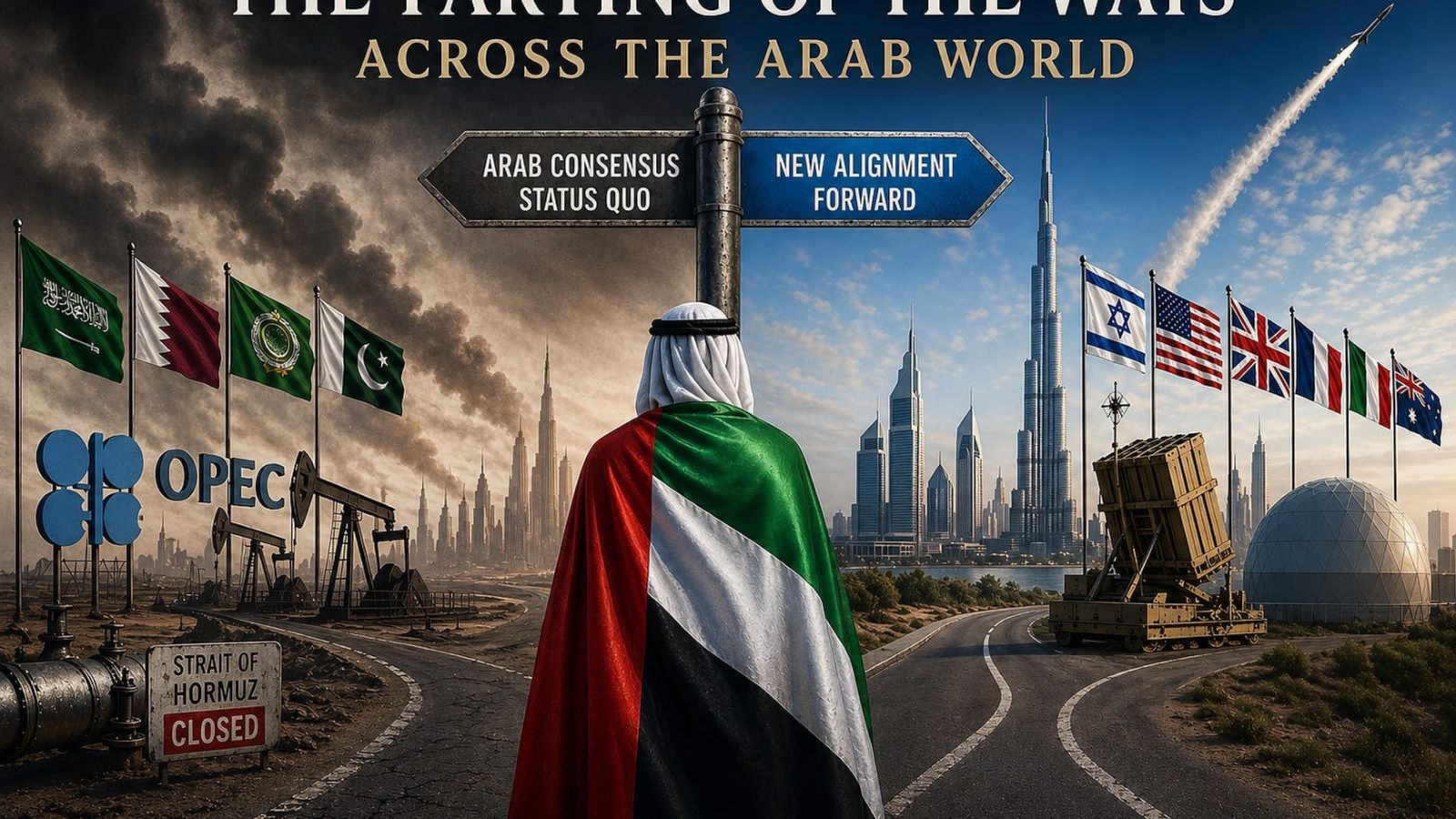
The war in Iran has just claimed its first victim: OPEC. The UAE's exit on Saturday leaves Saudi Arabia as the only member able to move prices by raising or lowering output. The producers who actually pump the most oil (the US, Canada, Brazil, Guyana) were never inside the cartel. With the Strait of Hormuz effectively closed, most Gulf members cannot get their oil out anyway, and the UAE has an alternative pipeline that bypasses the Strait — options other OPEC members do not have. OPEC is done.
Institutional failure
If leaving OPEC was not enough, Anwar Gargash, the UAE's long-time presidential diplomatic adviser, had signalled that the UAE would scrutinise its regional and international relationships. On Monday he named the GCC and the Arab League directly, calling their response to the attack on the UAE specifically "the weakest position in history".
Although an anonymous UAE official then told Reuters on Wednesday that any further withdrawals are not yet planned, the direction in which the UAE has been moving indicates that this is the beginning of a parting of the ways in the Persian Gulf and across the Arab world.
The UAE's reaction is not based simply on hurt feelings. It has been the country Iran attacked most heavily this time. Over the course of the war, Iran fired some 550 ballistic and cruise missiles and more than 2,200 drones at the UAE, more than at any other country, including Israel. Yet any attempts the UAE made to muster a united Arab front in response to Iran's indiscriminate attacks were rejected. In fact, on 8 April, hours after a US-brokered ceasefire was supposed to take effect, an Iranian refinery on Lavan Island was struck — Iranian sources and open-source analysts attributed the attack to UAE Mirage 2000 jets. On the same day, the Saudis were co-sponsoring a ceasefire framework.
Disagreement in the Making
However, the misalignment between the UAE and the other Gulf and Arab states was not caused by the war in Iran. The disagreements run deeper than that, and the war has only brought to a head a conflict that had been building for a while.
When Saudi Arabia signed a defence agreement with Pakistan in 2025, the UAE was unhappy – the UAE was deepening its ties with India, which is in an almost permanent state of conflict with Pakistan. On top of that, Pakistan's economy is structurally dependent on China, and the majority of its military technology is Chinese-made.
At the start of 2026, the UAE refused to extend its $3.45 billion loan facility, despite Pakistan asking for a two-year extension at a reduced interest rate. The loan was repaid in tranches in April, with the final payment on 23 April. Just two weeks earlier, on 11 April, Pakistan had deployed JF-17 fighter jets and military personnel to King Abdulaziz Air Base in Saudi Arabia under the Strategic Mutual Defence Agreement signed between the two countries in September 2025. Saudi Arabia replaced the UAE facility with $3 billion in fresh deposits to Pakistan's central bank and a year-long extension on $5 billion of existing loans.
So when Pakistan took the middle ground in the conflict instead of condemning the Iranian attacks on the UAE and other Gulf states, this was thought to have caused the Emirati ire. In fact, the UAE had been disengaging from Pakistan well before the US-Iran war began.
An Unlikely Ally
During the same period, the UAE was deepening ties with an unlikely regional ally — Israel. The UAE was one of the first countries to sign the Abraham Accords with Israel in 2020. This quickly led to a free trade agreement, intelligence and defence-industrial cooperation, and joint military operations.
In the early weeks of the war, as Iran was firing missiles and drones at the UAE in unprecedented numbers, Israel sent an Iron Dome battery, along with a contingent of IDF personnel to operate it, following a call between Netanyahu and Emirati President Mohammed bin Zayed. This was even as Israel itself was under attack from Iran. It marked the first time an Iron Dome battery was deployed outside Israel and the US.
In an article for the Arab Gulf States Institute, Tareq al-Otaiba, a former official at the UAE's National Security Council, wrote that the United States and Israel had "proved to be true allies by offering support through extensive military aid, intelligence sharing, and diplomatic backing." A senior Emirati official quoted by Axios was blunter: it was "a real eye-opening moment, to see who our real friends are." That list, the official said, also included France, the UK, Italy, and Australia. No GCC member appeared on it.
Going West
The differences go beyond military alliances. The UAE has been at odds with Qatar for over a decade over Doha's hosting of the Muslim Brotherhood, which the UAE designates as a terror group. That dispute now extends to the UK, where the Brotherhood remains perfectly legal and Qatari money is a major source of funding for British universities. The UAE has recently banned its students from attending UK universities — Emirati students, it seems, were coming home radicalised, and the UAE was unhappy about it.
The UAE is no longer prepared to wait for either Arab or Western consensus to catch up to its own position on political Islam.
While the Saudis aligned with Pakistan and by extension with China, the UAE aligned with Israel, the US, and the wider West. And leaving OPEC is only the first step in what looks to be the parting of the ways across the Arab world.