This past week has seen a flurry of activity from Vladimir Putin. On 28 June, he spoke to the United Russia party congress, to the heads of Russia's largest oil companies, and appeared in an interview with state TV propagandist Pavel Zarubin while visibly reading from a teleprompter. On 3 July, he participated in the recording of a staged visit to what was presented as a military command post. And on 4 July, he spoke to Donald Trump on the phone, which was publicised by Putin's foreign policy aide Yuri Ushakov.
All of this is happening against the backdrop of a severe fuel crisis and the unravelling economic catastrophe the likes of which Russia has not seen for decades. For somebody who has a habit of disappearing from public life at the first sign of any trouble (as he did when the submarine Kursk went down), Putin has suddenly become extremely active. This does look like a bog-standard damage limitation campaign; however, this time it is obviously not working. Because this time it is not only his adversaries who are noticing that the reality and Putin's version of events are not just diverging but essentially located in completely different universes. This time the mismatch is visible across his entire kingdom.
The Disappearing Act
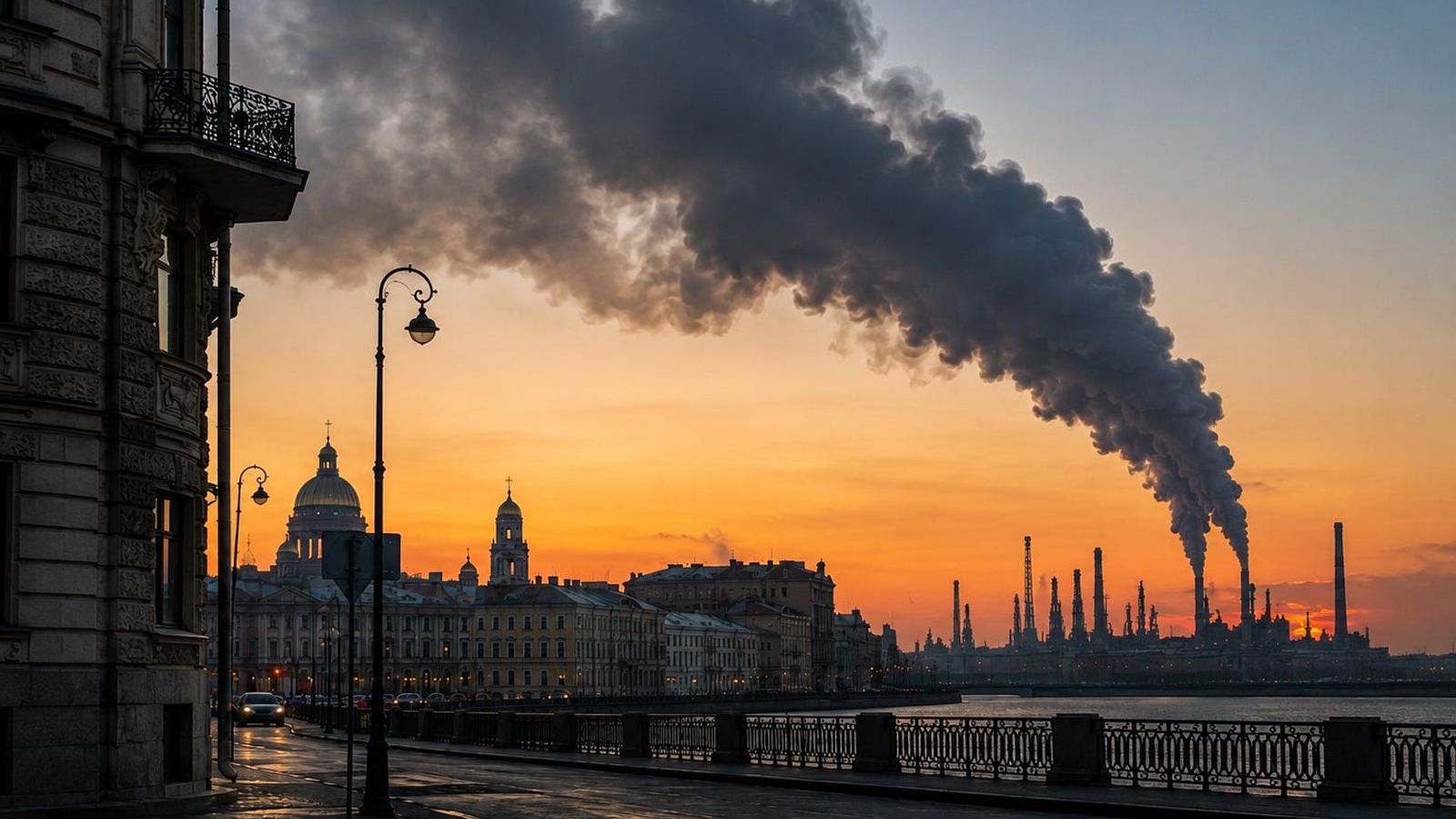
The first serious signs of the impending crisis were in early June, when Ukraine played with Russia like cat and mouse, hitting targets in St Petersburg on 3 and 4 June, on the eve of Putin's appearance at the St Petersburg International Economic Forum. His appearance there on 5 June, during which he completely ignored the mayhem Ukraine had caused in his native city, was his last public appearance for almost three weeks. He did not react to attacks on oil refineries and storage tanks, nor to the burning 15th Naval Arsenal near St Petersburg. There was no comment from him after the largest drone attack on Moscow of the entire full-scale war on 18 June. By the time he felt capable of facing the public on 28 June, only two of Russia's ten largest refineries were left untouched, and only because both of them were beyond the Urals.
In the meantime, even before the fuel crisis, discontent had been brewing on many levels.
In mid-March, Ilya Remeslo, a pro-Kremlin blogger and lawyer, posted a call for Putin to face trial and labelled the war a "dead end". He was taken to a psychiatric hospital in St Petersburg the following day but was later released and is still posting what would normally amount to "discrediting the armed forces" and would earn anybody else a one-way ticket to a Russian penal colony.
Victoria Bonya, a Russian beauty influencer living in Monaco with 13 million Instagram followers, posted a video in April addressed directly to Putin, complaining about catastrophic flooding, internet blackouts, livestock culls and economic pressure. The Kremlin uncharacteristically acknowledged the video, and the story died down.
While Bonya was contained and Remeslo, despite piping up from time to time, was seen as more of a product of mental illness due to his stint in a psychiatric hospital, what both of these individuals did and what the Kremlin could not stop was that they put a name to the problem. Both named Vladimir Putin as the person responsible. And both are still alive and unmolested.
The Floodgates
This seemed to open the floodgates. Suddenly, it was fine to admit that the budget deficit, unrelenting inflation and sky-high interest rates were the result of the war that would not end.
The massive losses of military personnel, coupled with slowing or even reversing advances of the Russian army and regressive management methods in the army, were dragged into daylight when a Russian combat veteran named Alexander Lunin posted a video on 25 June demanding a live meeting with Putin, threatening that the army would "turn its weapons against the Kremlin" if ignored. This happened almost exactly three years after Prigozhin's mutiny. The video reached 12 million views within 24 hours. Lunin was arrested two days later, but he is no longer an anomaly.
All this, coupled with internet blackouts orchestrated by the FSB and now fuel supply collapse, created a situation where multiple problems all had one culprit: the Kremlin, aka Putin. Public figures from within the system were no longer staying silent – German Gref, the head of Sberbank, Russia's largest bank, said on state television that he did not know a single person "who isn't concerned about anything other than a rapid end of hostilities."
And if that was not enough, the fuel shortages created the very situation the Kremlin had been trying to avoid since the start of 2022. In a country where any public meetings and manifestations are still banned, citing reasons ranging from tree inspections to, yes, still-active COVID restrictions, many people are now congregating in the same spots looking for fuel. And although for now they seem to be more interested in fighting each other for any fuel scraps thrown their way, eventually their collective mood might swing in the direction of those responsible for the debacle.
Matching Reality
While the overall consensus is that the USSR collapsed mostly due to catastrophic economic failures, one of the major contributing factors most people disregard was the stark disparity between reality and the public message from the ruling class. Empty shelves at the shops and claims of economic superiority over the West did not land the desired message.
This is why in a repressive state like Russia the message the state sends to its subjects cannot diverge sharply from what these subjects can observe with their own eyes. After local governments took the "fuel shortage was created by panic buying" line as far as they could, the Kremlin had to acknowledge the problem to some extent. However, Putin's plan, according to the teleprompter interview, was not to stop the war. Quite the opposite: he assured everybody that Russia would continue fighting until all goals were met, not that anybody knows what those goals are.
As a solution, Putin demanded increased production of air defence systems and fuel, and later, at what was presented as a military command post on 3 July, he ordered the creation of a buffer zone in Ukraine as a way to decrease attacks on Russia. As if ordering increased production of fuel and the creation of a buffer zone could magic them into existence and stop Ukrainian attacks. Putin has been ordering the creation of a buffer zone for a few years now, and the buffer zone has not complied.
It is becoming clear that Russia cannot stop Ukraine from attacking its oil infrastructure and military targets. While the size of the Russian Federation is a particular source of pride for Russians, this is where they might have wished they had not absorbed quite so many neighbours. Ukraine, well over twenty times smaller than Russia, has a job maintaining adequate air defence, and it has all of NATO to help it. Russia is virtually unprotectable in this sense. The situation is going to get worse.
Traditionally, when autocrats face domestic problems, they tend to look for an external outlet to let off steam. When Russia seized Crimea in 2014, it was an exercise intended to increase Putin's popularity at home, as was the case with the Russo-Japanese War of 1904, launched partly to shore up the Tsar's flagging domestic standing.
So it is no wonder that in his speech on 3 July, Putin tasked his general staff with determining which countries were preventing Ukraine from capitulating and coming up with an appropriate course of action.
Deflecting the Problem
In the light of this, the US warning to Poland, which became public on 3 July, about a possible Russian armed provocation designed to test NATO's resolve and pressure Kyiv's partners into suspending aid to Ukraine, as well as the Latvian intelligence service's warning of 23 June that Russia is preparing hybrid attacks against the Baltic states or Poland including drone and missile strikes, should not be taken lightly. Russia is also doubling down on its claim that the Baltic states have opened their airspace for Ukrainian drone strikes on Russia, which functions as a ready-made pretext for retaliation. The domestic pressure Putin is facing is growing. He needs to show he is still a predator, especially to his own people. As he did before, and as many have done before him, Putin might deflect the problem by moving it elsewhere, even if just for a while.
As long as he believes NATO will not respond, or that the response will not be painful enough to affect him personally, he might deploy a limited test or two against one of the neighbouring states, although it is highly unlikely to be a direct military aggression at this time.
However, none of this means the end is near.