
When Donald Trump returned to the White House, he promised to end the war in Ukraine by negotiating a deal between the warring parties, applying pressure on the party resisting the peace effort. We will never find out what would have happened had Washington actually tried to apply any pressure on anybody other than Ukraine. After Secretary of State Marco Rubio announced that the peace process had stalled and Washington was done waiting for results, many parties exhaled in relief. Not because they did not want peace but because the path chosen by Washington was never going to lead to peace.
Six days later, the EU, having mulled over the idea of appointing their own negotiator for talks with Russia, withdrew from the idea — and demonstrated how pointless they considered any negotiations with Russia by allowing EU High Representative for Foreign Affairs and Security Policy Kaja Kallas to revert to form. She declared that before any talks could begin, Russia would first have to agree to an unconditional ceasefire, withdraw its troops from Moldova and Georgia, reduce its armed forces, and cease its sabotage operations, cyber-attacks, and airspace violations across Europe. There was finally no need to pretend that anybody believed Russia in its current state could be reasoned with.
Then there was Zelenskyy's letter to Putin, in which he invited Putin to a face-to-face meeting (for an umpteenth time), called on him to end the war, and (the real reason the letter was sent) warned that Russian history does not favour rulers who do not know how to get out of sticky situations.
Why, if Trump no longer needs appeasing, is Ukraine still pretending that Russia can be reasoned with?
A Message Worth Looking Into
When Ukraine's officials issue a statement, it usually has a very specific purpose. We might not see that purpose for a while, but most of the time it becomes clear eventually. In this case, the important parts are the message and who it is addressed to.
The message Ukraine is sending is not that it expects Russia to come to its senses. It is that Ukraine intends to force Russia to see the reality in a new light. Looking at Ukraine's long-term plans that are finally coming to fruition, it is becoming clear that Kyiv is not talking of diplomacy at all. It is talking of negotiations where one side is being hammered from several different directions at once — directions it did not see coming — until giving up its goals in Ukraine no longer looks quite so unattractive.
Several events are converging at the moment. Following a personnel change at the start of the year, the new Minister of Defence Mykhailo Fedorov declared a new direction in the fight against Russia — Russian troop targets. If more men could be eliminated by Ukraine than can be recruited by Russia, Russian fighting capabilities would start shrinking.
In addition to this strategy, the middle-strikes programme finally came into its own earlier this year. The kill zone — the area around the front line reachable by drones — has extended from around 20 km to 150 km, and in some cases 200 km. Crucially, this reach applies to Ukrainian middle-strike drones, not Russian ones. Suddenly, Ukraine is capable of taking out equipment and manpower supply routes deep in the enemy's rear, while Russia does not have the same options.
This has compounded the loss of manpower and supplies to such an extent that Russia has virtually stopped advancing. According to the Ukrainian monitoring group DeepState, May 2026 marked the first month since 2023 in which Russia lost more territory than it gained; the Institute for the Study of War, using a different measure, dates the previous net loss to Ukraine's Kursk incursion in 2024. Either way, the direction is the same — a reversal that would have been unthinkable a year ago.
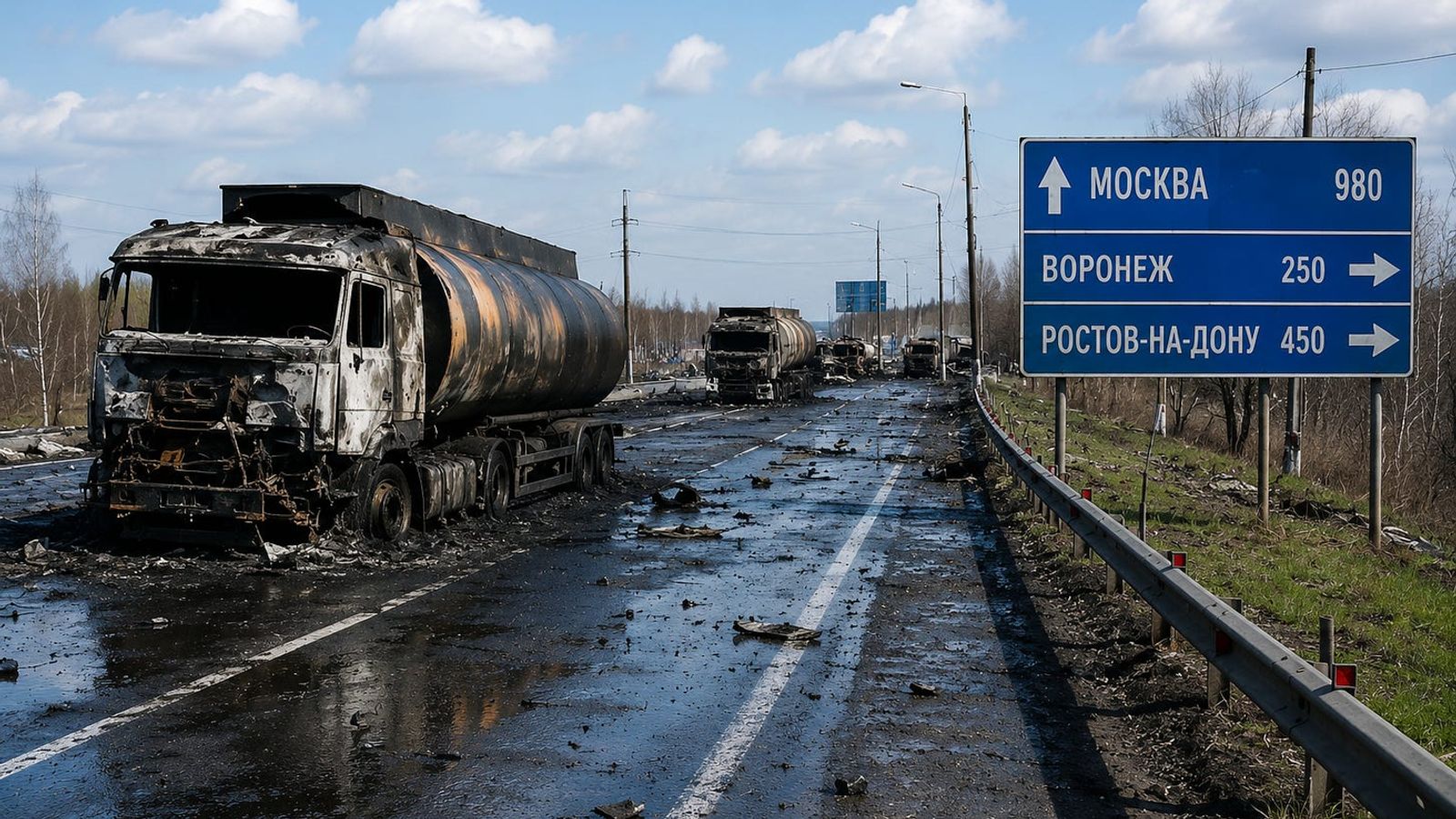
In addition to this, the campaign against the Russian energy industry is finally coming together. Having struck ports, fuel production facilities, and pumping stations, Ukraine has simultaneously forced Russia to reduce oil production — hitting the Russian budget — and driven it into a serious fuel crisis. There are fuel shortages across most of European Russia, and attacks on pumping stations are blocking deliveries from Western Siberia, while the insufficiently developed rail and road infrastructure provides no meaningful relief.
If that were not enough, the same fuel crisis in tandem with middle-strike drones is affecting Crimea especially hard. Following repeated attacks on the Kerch Bridge connecting mainland Russia with occupied Crimea, Russia stopped using it to transport fuel and ammunition — afraid of another strike turning any flammable cargo into the weapon itself. Ukraine then systematically picked off the ferries Russia had been using to supply the peninsula across the Kerch Strait instead, disabling the last of them in April 2026.
With supply by water now impossible, and rail routes through the occupied territories within reach of Ukrainian attack drones, Russia is left with an unwelcome choice: use the bridge to resupply the peninsula and risk exactly the kind of spectacular strike Ukraine has been waiting for, or leave Crimea without adequate supplies. If I were a betting woman, I would put a lot of money on Ukraine waiting patiently for a sufficiently explosive cargo to cross the bridge before finishing the job for good.
At the start of the full-scale invasion, the Kremlin touted the establishment of the land corridor to Crimea via the newly occupied territories as a palpable result of the invasion, sold to their own population as success. This land corridor is so vulnerable now that it is effectively gone, turning Crimea from an asset into a sitting duck.
These are the negotiations that Ukraine is conducting at the moment. And it seems that they expect the first realisation of the impending disaster to hit the Russian side just before winter. Hence the assessment of possible end of hostilities by winter.
For Whom the Bell Tolls
This was the answer to the question of what message the Ukrainian side is sending. Now, who is the message intended for?
It cannot be intended for Europe — Europe knows the score all too well without any outside direction. The message can therefore be meant for the US or Russia. While the US would appreciate the chance to take ownership of at least one war properly finished under its ministrations, by the time the measures instituted by Ukraine finally come to a head, the midterm elections will be over and Trump will most likely have lost the Republican majority in Congress.
Which is why this message is most likely intended for Russia. Even Zelenskyy's letter to Putin. Not for the population, which has no mechanism and no history of acting, but for the small circle around Putin who can. The ones who risk losing their fortunes, lifestyles and access to power, and who will eventually have to calculate whether hastening his demise is less dangerous than riding the war down with him. There is no way to know how deep their pain threshold runs. It would seem that Ukraine expects them to get the first hint by the end of this year. How many hints it will take before the message finally sinks in, is anybody's question.