The state of the Russian economy has been discussed in the news from all sides. There are predictions of both its imminent demise and relative immortality. There are calculations on how the Strait of Hormuz oil crisis affects it, and just recently there was an excellent report from Swedish military intelligence on artificial inflation of Russian economic prowess.
All of these view the collapse of the Russian economy as the final desirable outcome, and even Russian economists in exile are not rooting for Russian economic deliverance. The consensus is that it is going to collapse eventually, and nobody really knows when.
But What Do We Expect Such Collapse to Achieve?
It is generally accepted that wars end when parties change their goals or have exhausted their physical, military, and economic potential for continuing them. While waiting for Russia to change its mind on wanting to conquer neighbouring states might take a few lifetimes, the economic collapse is quite reasonably expected to serve as an objective limiting factor in its expansionist agenda. When people are starving, even hardened regimes have to turn inwards. By mapping the impending economic doom, we should be able to anticipate how long Russia can continue the war in Ukraine and plan our own actions.
However, these arguments discount the real variable in the equation — the Russian people. There is not much point in commenting on the health (or lack thereof) of the Russian economy if its people react in a completely different way than they would in countries where human life is a value.
And because of this variable, even when the Russian economy finally collapses, we may not notice — because collapse in Russia is unlikely to produce the visible markers the West is trained to read. It will not arrive as mass protest or regime fracture. It will arrive as degradation, absorbed by society and redirected into the war effort.
In a word, we are watching for the wrong metric. In a country where the pain threshold is close to that experienced in Europe in the Middle Ages, economic data on paper does not translate into results as expected.
Train Wreck Already in Progress
Generally, an economic collapse is marked by currency collapse, bank runs, default, hyperinflation, mass unemployment, and societal unrest. Some of these have already happened, and some are well on the way there.
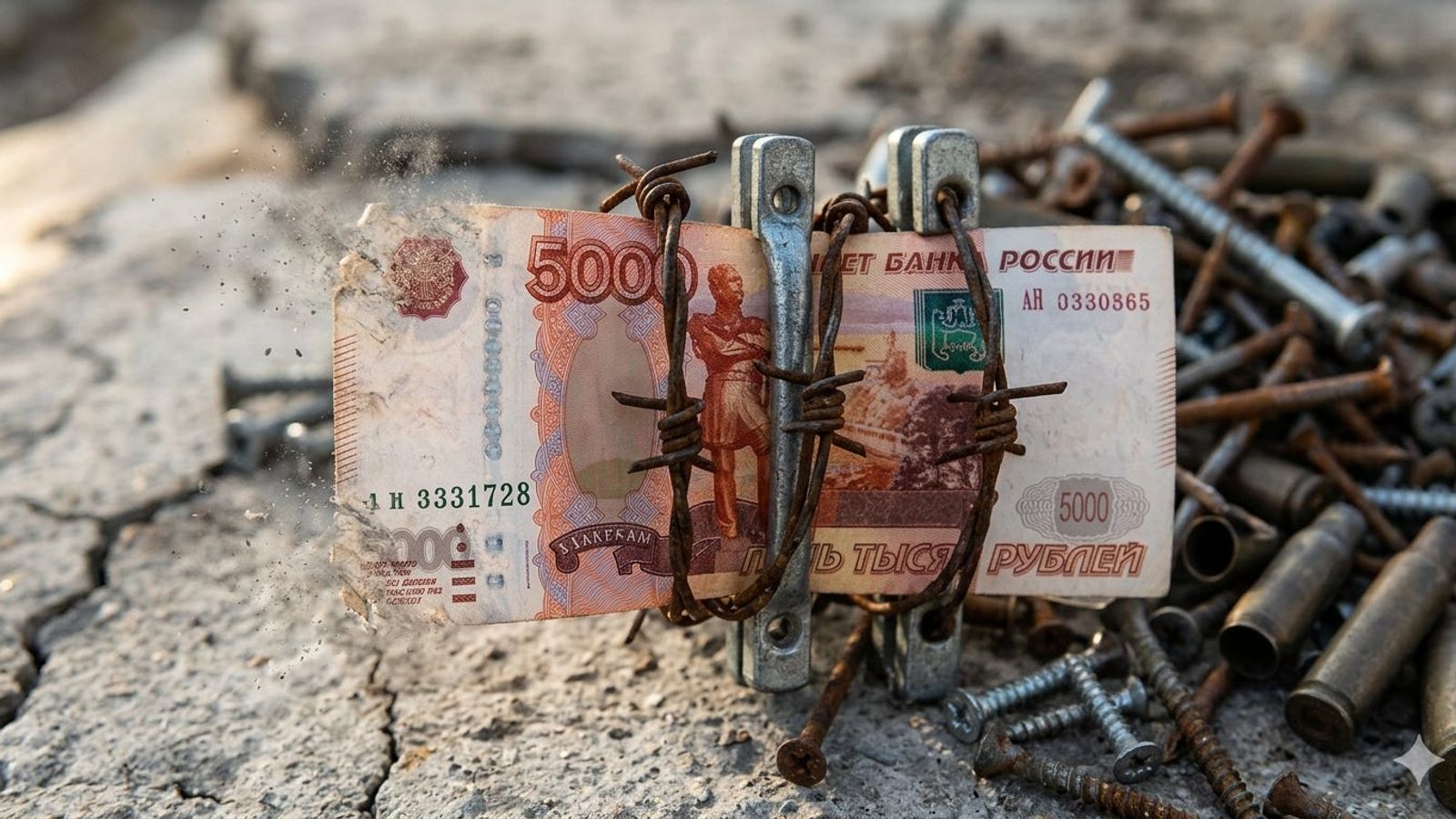
The rouble has been maintained artificially since 2022. The Russian Central Bank effectively sacrificed it and the Russian economy at the start of the war by taking steps that were meant to retain the appearance of stability, instead of actually stabilising the situation. As most investment was withdrawn from the Russian economy (and no, China does not bring in investment, it extracts resources — even in Russia), Russia had to battle the mixture of cash shortage and post-Covid inflation with the only means possible — high interest rates. This has had a negative effect on the already battered economy and caused a loop where economic medicine effectively kills the patient — the economy. Caught between the inflation caused by printing money and the business collapse caused by high interest rates, the Central Bank is simultaneously administering both remedies, each of which makes the other necessary. The war budget cannot be cut, oil revenues are falling, and the deficit is being financed by money printing that the high interest rates cannot fully offset — the balance is holding only because it has not yet broken.
Some version of the signals of collapse have already happened. The currency is maintained artificially. The ordinary population attempted to withdraw their foreign currency deposits in 2022 and was blocked, capped at $10,000 in cash, with any remaining balance only accessible in roubles at the Central Bank's rate, restrictions that remain in force today. There is a form of bank run happening at the moment in response to the blocking of internet services — if the only way to pay for services is cash, since the card machines do not work, then keeping money in the bank is useless. This is evidenced by $19.7 billion withdrawn in cash in January alone. Technical default has already happened in June 2022. Each of these would register as a crisis signal anywhere else. In Russia, they are absorbed as the new normal.
Curiously enough, mass unemployment is happening alongside mass worker shortages — there are areas, especially rural ones, where no work can be found, and areas where companies cannot find enough workers. Mobilisation and the wartime defence industry have stripped labour from civilian sectors, creating acute shortages in some regions while the collapse of import-dependent manufacturing and retail has left others with nothing to employ people in.
Unrest That Is Not Happening
The only element we have not seen and it seems will not see is societal unrest, which should be the culmination of descent through the ranks and the sign of changes to come.
Unlike the situation in Iran, where economic hardship can potentially cause the change of regime because people there are unhappy and have agency, people in Russia are usually unhappy but they have no agency. Russians historically have high tolerance for pain and abuse, and the current generation is not very different. They are used to decisions being made for them, not by them.
These are people who can be press-ganged into military, can be tortured by their commanders, abused, and then sent on suicide missions on the front, and instead of turning their weapons against their torturers, they follow the orders and die.
These are also the same people who already experienced the collapse of the economy in the 90s following the disintegration of the USSR. The common response was to organise a criminal gang and survive by robbing others. They are now effectively doing the same — killing and robbing their neighbours in hopes that it will serve as a reprieve for them.
Total Pressure on Totalitarian State
Russia has almost completed the transition from authoritarian state to totalitarian, achieving a form of control the Soviet Union itself did not fully reach, one that extends into private life, private relationships, and private thought. The totality of the government's control is very close to what it used to be in the Soviet Union. The only two differences — there is some semblance of private property in modern Russia, and people are allowed to leave. All other aspects of human life come under complete control of the state. In the absence of any grassroots movements and the complete absence of any horizontal societal bonds, these people will learn to live in the conditions of a collapsed economy just as they have learned to live with sending their loved ones to die in another country in exchange for generous compensation packages.
However, this is not an argument against applying economic pressure on Russia. Quite the opposite. Extreme sanctions are needed to elicit even a modicum of reaction from the people who are used to very brutish life, as well as elites, who have no power but will follow anybody who has finally had enough. The security apparatus is the last to notice and the last to care — repression offers its own rewards that a salary cannot fully explain.
Just recently, Gennady Zyuganov, leader of Russia's Communist Party and a derivative of the system, warned the Russian State Duma that without urgent action to improve the economy 'a repeat of what happened in 1917 awaits us.' Apart from the irony of a communist warning about the imminent approach of a communist 'revolution', this serves as the indication that the system, far from collapsing, is still allowing its loyal fixtures to let off steam. Albeit with consent.
The metric worth watching is not economic. In a totalitarian state, the real signal of systemic fracture is escalating repression. A stable regime does not need to resort to additional punishment to stave off dissent, it only does so when the existing level of control is no longer sufficient. And when the system runs out of real enemies and starts consuming its own (loyalists, collaborators, true believers – Zyuganovs, in other words), we can expect change. Watch for that, not GDP.