The reason many people follow the US-Iran war events is the uncertainty around oil prices and their effect on the global economy and by extension the household bills. We want to know how long this is going to last, mostly to figure out how bad it is going to get. Following the Washington administration's logic is no easy task, however, oil markets seem to have made up their mind about what lies ahead. What do current oil prices tell us about the direction of the conflict and the economic pain it will inflict globally?
Tactical and strategic
First things first. There are two types of oil prices – futures and spot prices.
As the name indicates, futures relate to deals for the sale of barrels of oil in the future. Generally, a few months down the line. The oil sold this way usually has not been loaded on a ship yet; what's more, it might still be in the ground. The energy market factors in the difficulties associated with extraction, loading, and transportation. Essentially, this is the price the market has determined oil will be worth by the time it is ready for delivery, accounting for everything that might affect supply between now and then.
Spot prices, on the other hand, apply to oil not only extracted, but already loaded on a ship, and in some cases even delivered. It is the price the buyer pays for the specific boatload of oil on the spot – hence the name, as "spot" means immediate, on-the-spot delivery. Oil sold this way can sell for a lot more or a lot less than futures because its price is affected by the global and economic events of the day. On days when there is plenty of oil on the market, an additional discount might be needed to offload it, and during shortage periods any additional geopolitical events can send it sky high.
In simple terms, futures define the long-term, strategic outlook on the overall state of the global economy as it pertains to oil. Spot prices reflect only current events, without taking into account how they will develop past a certain point in time and are mostly an opportunistic indicator.
The bigger the crisis, the calmer the market?
Since comprehensive oil price records began in 1988, the world has seen three most comparable supply-shock crises – in 2008, 2022, and now in 2026.
At the height of the 2008 crisis, futures prices peaked at $146.08, and spot prices tracked almost identically, reaching $143.95. This crisis was not caused by a supply disruption. It was demand-driven and speculation-amplified as a result of the swift growth of the Chinese economy.
The 2022 crisis was closer in nature to the current one. It was based on a shortage of oil, albeit a virtual shortage – the oil had not left the market. However, markets reacted in anticipation to what would happen if that oil was removed from the market. Futures prices reached $127.98, while the spot prices went slightly higher – $133.18.
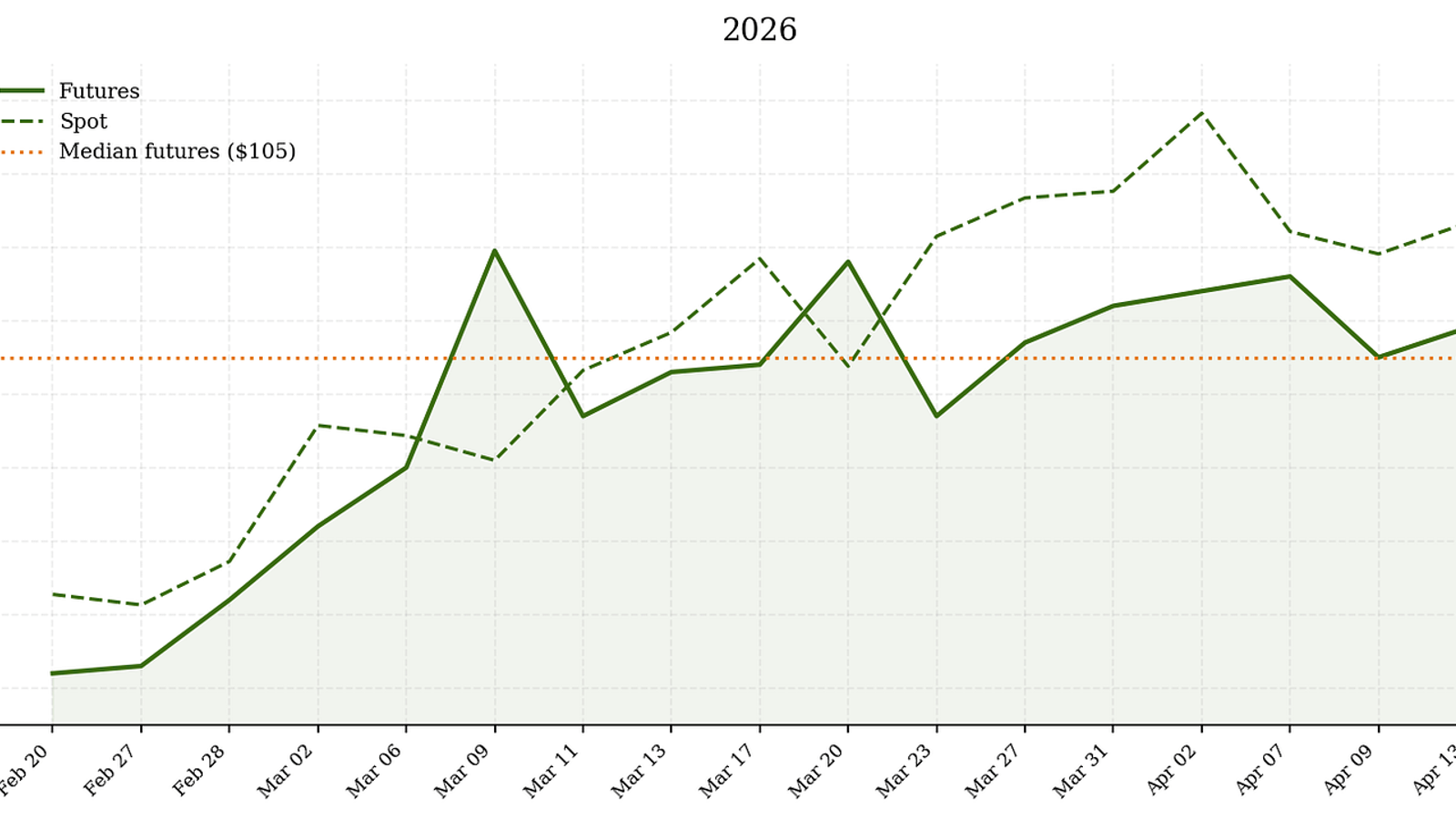
The current crisis so far has also been caused by a virtual shortage of oil. It is worth noting that an oil shortage only starts from the moment deliveries no longer arrive at their destination, not from the moment they no longer ship — meaning we have not yet experienced the full physical impact of the Hormuz closure. Futures prices peaked at $119.50. Spot prices, unlike before, have jumped far higher, reaching $138.21.
What does that tell us?
Speculative trade in 2008 created more pain for consumers than real physical shortages that are already materialising in 2026.
Despite the possibility of a real oil deficit, the markets are less worried about its impact than they were in 2022 when the withdrawal of roughly 12% of globally traded crude oil (Russia's share at the time) was contemplated, compared to the 20% of globally traded crude oil currently locked up in the Persian Gulf.
What is remarkable though, is that while spot prices are yo-yoing and seemingly following Donald Trump's tweets rather closely, futures markets appear to be ignoring them entirely and holding what looks like a pre-determined course. They hover steadily around a $105 median.
This tells us that the markets are expecting to ride out the current crisis and do not currently expect disruption beyond what has already occurred. There are various reasons for this – they might genuinely believe that the US and Iran have already done their worst; they can bank on the ability of free market economies to adapt to most circumstances, or they might remember that mid-term elections in the US are coming up, and Donald Trump should (one might think) want to put this conflict to rest by then.
Therefore, if we are to believe the oil markets, they expect more of the same for now, and most probably no serious change until closer to the US mid-term elections. Which is probably more stability (albeit at a higher price than we would like) than we have seen these last couple of months.